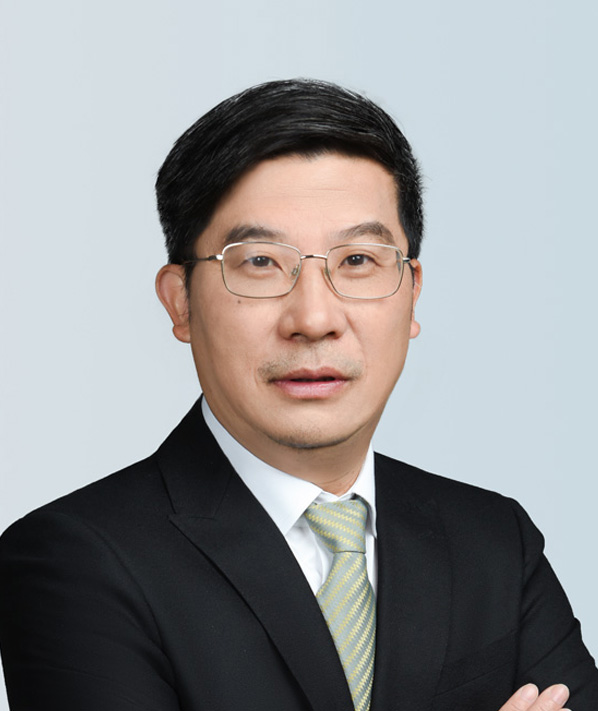
南方科技大学医学院副院长、教授。曾任德克萨斯大学健康中心教授,着重研究蛋白质稳态调控的机理和功能。培养40多名学生,博士,博士后。研究长期被美国NIH,癌症协会及多个私人基金会支持。担任多个国际基金评审专家和学术杂志编委。课题组的研究在多个国际杂志发表包括Nature,PNAS,JCB,JBC,Cancer Research,Nature Communications, JMC等等。实验室擅长传统的生物化学、遗传学、分子细胞生物学,也精通先进的蛋白质组学、高通量筛选等。对蛋白质泛素化及随之引起降解在生理和病理上的重要性有很深的了解和心得,也对相关的技术开发有独特的想法并获得一项国际专利PCT。在国际上领域内有优秀的声誉,和国内外多个实验室建立了合作关系。2020年底回国后,实验室已经获得国自然面上项目、科技部国家重点研发计划“合成生物学”重点专项及深圳面上及重点项目,同时组建广东省新陈代谢与健康普通高校重点实验室。近5年,发表高水平论文16篇,申请专利4项,团队原创工作角度有特色,发现有引领,在蛋白质泛素和降解领域中长期得到普遍认可。
蛋白质稳态在健康和疾病功能影响。蛋白质稳态和质量控制对细胞的正常生命活动至关重要。蛋白质稳态异常导致多种疾病,包括肿瘤和神经退行性疾病。实验室主要利用酵母菌和人的细胞体系, 开展蛋白质修饰和泛素化引起蛋白质降解的机理研究。在此基础上,我们将研究蛋白质稳态调控机制及其在多项疾病包括癌症和老年神经性疾病中的作用。具体研究方向有以下:
1)利用酵母菌做大规模的筛选与蛋白质稳态调控疾病有关的基因。
2)蛋白质泛素化是如何调控细胞内各种通路(包括DNA修复,细胞周期调控,自噬autophagy等等)。蛋白质泛素化裂解的一个最重要的作用就是帮助细胞迅速适应新挑战和变化,比如DNA伤害,细胞周期变化和各种stress。我们一直在关注蛋白质裂解在这些方面的贡献,有一定的经验和基础,也将做筛选来确定其功能和影响。
3)蛋白质泛素化技术应用,发展新的治癌药物和治疗方法。我们已经在设计新方法把导致人体疾病的蛋白质快速降解,来开发其治疗效应。
4)泛素化如何通过调控蛋白质的质量而可能参与老年神经性疾病的发展。我们在这方面已有一定的基础,对多个有折叠错误而被裂解多蛋白有深刻的研究。
1985.09 - 1989.07 武汉大学 化学 学士;
1989.07 - 1991.05 波士顿大学 化学 硕士;
1991.09 - 1996.12 纽约州立大学石溪分校及冷泉港实验室 生物化学 博士
1997.01 - 2002.08 加州理工学院 生物 博士后;
2002.08 - 2020.10 德克萨斯大学健康中心 助理教授,(终生)副教授,(终生)教授;
2020.10 - 2025.02 南方科技大学医学院 教授、生物化学系主任
2024.03-至今 南方科技大学医学院 教授、医学院副院长
2006年,美国 癌症研究协会少数族裔院校教授学者奖
1998年-2001年,美国白血病基金会博士后奖
1996年,纽约州立大学石溪分校博士生研究奖
多个国际杂志的编委 包括 J. Biol. Chem.; Frontiers in Cell and Developmental Biology and Oncology; Adv. In Biol.,; J. Membrane Sci. Tech.
在德克萨斯大学担任各级院校研究生及教授委员会委员
1. Rao, H., Marhrens, Y. and Stillman, B. (1994) Functional conservation of modular elements in yeast chromosomal replicators. Mol. Cell. Biol. 14: 7643-7651.
2. Rao, H. and Stillman, B. (1995) The origin recognition complex (ORC) interacts with a bipartite DNA binding site within yeast replicators. Proc. Natl. Acad. Sci. USA 92: 2224-2228.
3. Rao, H., Uhlmann, F., Nasmyth, K. and Varshavsky, A. (2001) Degradation of a cohesin subunit by the N-end rule pathway is essential for chromosome stability. Nature 410: 955-959.
4. Rao, H.* and Sastry, A. (2002) Recognition of specific ubiquitin conjugates is important for the proteolytic functions of the UBA domain proteins Dsk2 and Rad23. J. Biol. Chem. 277: 11691-11695.
5. Kim, I., Mi, K. and Rao, H. (2004) Multiple interactions of Rad23 suggest a mechanism for ubiquitylated substrate delivery important in proteolysis. Mol. Biol. Cell. 15: 3357-3365. PMCID: PMC452589
6. Kim, I., Ahn, J., Liu, C., Tanabe, K., Apodaca, J., Suzuki, T. and Rao H. (2006) The Png1-Rad23 complex regulates glycoprotein turnover. J. Cell Biol. 172: 211-219.
7. Kim, I. and Rao, H. (2006) What’s Ub chain linkage got to do with it? Science STKE 330: pe18.
8. Liu, C., Apodaca, J., Davis, L.E. and Rao, H. (2007) Proteasome inhibition in wild-type yeast Saccharomyces cerevisiae cells. Biotechniques 42: 158-162.
9. Liu, C., van Dyk, D., Li, Y., Andrews, B. and Rao, H. (2009) A genome-wide synthetic dosage lethality screen reveals multiple pathways that require the functioning of Ub-binding proteins Rad23 and Dsk2. BMC Biol. 7: 75.
10. Liu, C., Choe, V. and Rao, H. (2010) Genome-wide approaches to systematically identify substrates of the ubiquitin-proteasome pathway. Trends Biotechnol. 28: 461-467. PMCID: PMC 2926183
11. Baek, G.H., Kim, I., and Rao, H. (2011) The Cdc48 ATPase modulates the interaction between two proteolytic factors Ufd2 and Rad23. PNAS 108:13558-63.
12. Baek, G.H., Cheng, H., Choe, V., Bao, X., Shao, J., Luo, S., and Rao, H. (2013). Cdc48, a swiss army knife of cell biology. J. Amino Acids 2013, doi 10.1155/2013/183421.
13. Krzeszinski, J., Choe, V., Shao, J., Bao, X., Cheng, H., Luo, S., Huo, K., and Rao, H. (2014) XPC promotes MDM2-mediated degradation of the p53 tumor suppressor. Mol. Biol. Cell. 25, 213-221.
14. Shao, J., Choe, V., Cheng, H., Tsai, C., Weissman, A., Luo, S. Rao, H. (2014) Ubiquitin ligase gp78 targets unglycosylated prion PrP for ubiquitylation and degradation. PLos One e92290.
15. Cheng, H., Bao, X., Gan, X., Luo, S. and Rao, H (2017) Multiple E3s promote the degradation of Histone variant Cse4. Scientific Reports 7: 8565.
16. Shanmugasundarum, K., Shao, P., Chen, H., Campos, B., McHardy, S., Luo, T., and Rao, H. (2019) A modular PROTAC design for target destruction using a degradation signal based on single amino acids. J. Biol. Chem 294: 15172
17. Rao, H., J. Che, C. Yin, Y. Zhou, Y. Ma and R. Tian (2022). "How many authors does it take to publish a high profile or classic paper?" Mol Biol Cell 33(12): pe6.
18. Zhang, J., C. Ma, Y. Yu, C. Liu, L.Fang and H. Rao (2023). Single amino acid-based PROTACs trigger degradation of the oncogenic kinase BCR-ABL in chronic myeloid leukemia (CML). J. Biol. Chem: 299, 104994
19. Zhang, J., X. Chen, C. Chen, C. Ma, K. Liao, M. Su, C. Tan, L. Fang and H. Rao (2024). Distinct amino acid-based PROTACs target the oncogenic kinases for degradation in non-small cell lung cancer (NSCLC). J. Med Chem 67, 13666-13680. doi: 10.1021/acs.jmedchem.4c00208
20. Yan Z., L. He, J. Yuan, Y. Niu, S. Shuai, S. Luo, C. Du and H. Rao (2025). The splicing factor SRRM2 modulates two S6K kinases to promote colorectal cancer growth. Oncogene 44, 1284-1299.
21. Zhang, J., C. Chen,X. Chen, C. Chen, K. Liao, M. Su, H. Sun, C., Hou, C. Tan, L. Fang and H. Rao (2025). Linker-free PROTACs efficiently induce the degradation of oncoproteins. Nature Communication 16,4794.
22. Shen, L., Zhang, J., Wang, ZR, Liu Y., Cui, S., H. Rao (2025) Targeted degradation of α-synuclein by arginine–based PROTACs. J. Biol. Chem 301, 110449.
23. Chen X., Liao K., Yuan J., Zhang J., Rao H. (2025) Mighty miniPROTACs: an emerging class of degraders. Eur. J. Med Chem 301, 118202.